
Accelerating Marine Carbon Dioxide Removal Technology at AltaSea
Carbon sequestration, the reabsorption of past emissions from the atmosphere, is necessary to stop the climate crisis; it is estimated that in order to limit global warming to 1.5 degrees Celsius, one trillion tons of carbon dioxide (CO2) emissions must be removed from the atmosphere this century. The ocean is our planet’s largest carbon reservoir, capable of containing a larger quantity of carbon than the biosphere and the atmosphere combined, and marine carbon dioxide removal (mCDR) technology has gained traction as a potent carbon sequestration solution. AltaSea has become a proving ground for mCDR innovation, housing some of the sector’s leading blue businesses.
The oceans have absorbed at least one-third of humanity’s carbon emissions to date—at a severe cost to their own wellbeing. Excess CO2 in the ocean decreases the ocean’s pH and leads to ocean acidification, which harms vital marine species that build their body structures from calcium carbonate—including corals, shellfish, and plankton. Since plankton form the base of the ocean food chain, if they are too severely impacted by ocean acidification, it could potentially lead to the collapse of entire ocean ecosystems.
But mCDR technology is proof that all hope is not yet lost. Captura, a CalTech-associated blue technology company, is successfully operating a 100-ton-per-year ocean CO2 removal system at AltaSea at the Port of Los Angeles. The startup has designed a solution to the ocean’s over-absorption of CO2—a direct ocean capture system that runs with just two ingredients: seawater and renewable electricity. Using proprietary electrodialysis and gas extraction technologies, it captures CO2 directly from seawater to be permanently stored or reused.
The success of Captura’s 100-ton-per-year system at AltaSea has primed the company for large-scale commercialization and earned it a spot on TIME Magazine’s list of America’s Top GreenTech Companies of 2026. Captura was one of 17 carbon removal companies on the list, emphasizing the carbon sequestration sector’s necessary role in climate action. The growing importance of carbon removal technology is also visible in the sector’s economic prospects; the current market size for all carbon removal technology—including mCDR—is estimated at $2 billion, but is projected to grow to $50 billion by 2030.
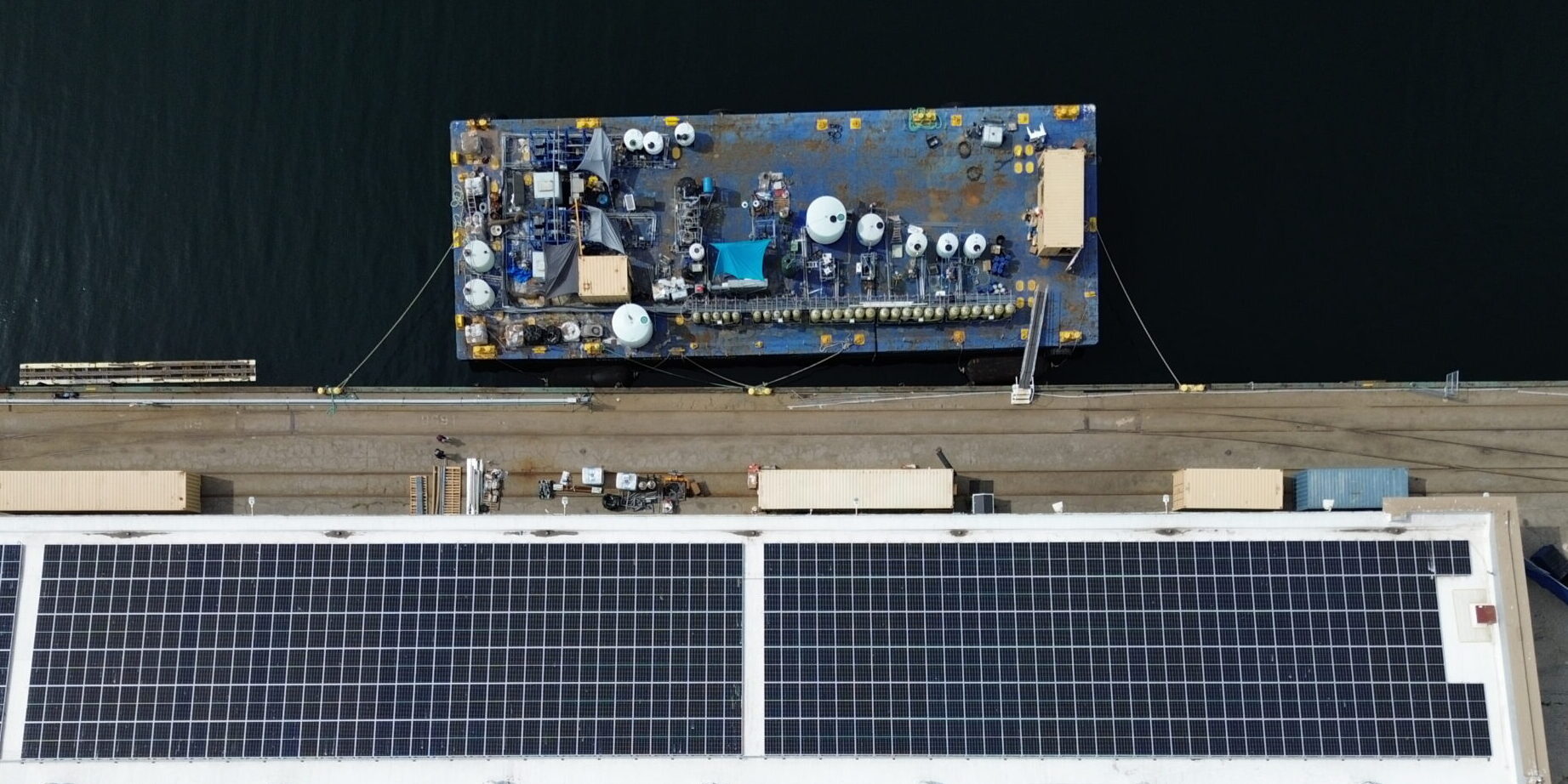
The other standout mCDR startup on the AltaSea campus is led by Gaurav Sant, the director of UCLA’s Institute for Carbon Management. UCLA has a research barge at AltaSea where Sant, UCLA students, and researchers work alongside each other at Sant’s mCDR startup, Equatic. Over the past several years Equatic has earned worldwide recognition; it was named one of TIME Magazine’s best inventions of 2023 and was a finalist for the 2024 Earthshot Prize.
Similar to Captura, Equatic’s technology also removes excess CO2 directly from the ocean. But Equatic’s process involves running an electrical current through captured seawater and locking away CO2 in rock-like carbonates. Equatic has also developed a way to produce green hydrogen gas—a powerful renewable energy—as a byproduct of the mCDR process. For his innovations in mCDR, Sant was listed on the 2024 TIME 100 list of the world’s most influential climate leaders. He continues to steward Equatic as it builds North America’s first commercial-scale ocean-based carbon removal facility, located in Canada.
Also on the AltaSea campus, researchers from CalTech have created a startup called Calcarea that combines mCDR with carbon capture technology. Calcarea’s technology captures emissions onboard ships as they are emitted in real-time, and then converts the emissions into oceanic bicarbonate salts—accelerating a natural reaction between seawater and limestone that usually takes over 10,000 years into a one minute process inside Calcarea’s onboard reactors. This unique approach shows how mCDR can work alongside carbon capture technology and renewable energy to rapidly decarbonize sectors that are traditionally thought of as difficult to decouple from fossil fuels, including maritime shipping.
The current success and future prospects of mCDR technology emphasize the blue economy’s core truth—the oceans hold solutions to the existential threats that humans face, and are an especially powerful source of climate change solutions. The next three decades are our only chance to stop human-induced climate change from permanently endangering the livability of our only planet. That means now is the time to accelerate the blue economy’s solutions, and AltaSea remains committed to supporting researchers on the frontlines of the battle against climate change.
Written by Emily Vidovich. Emily is an environmental journalist specializing in ocean conservation and climate change mitigation. She obtained her bachelor’s degree at George Washington University and a Masters in Global Environmental Studies at a university in Tokyo, Japan. Born and raised in the Port of Los Angeles, she now works in research and communications at AltaSea.