
Charting A Cleaner Course
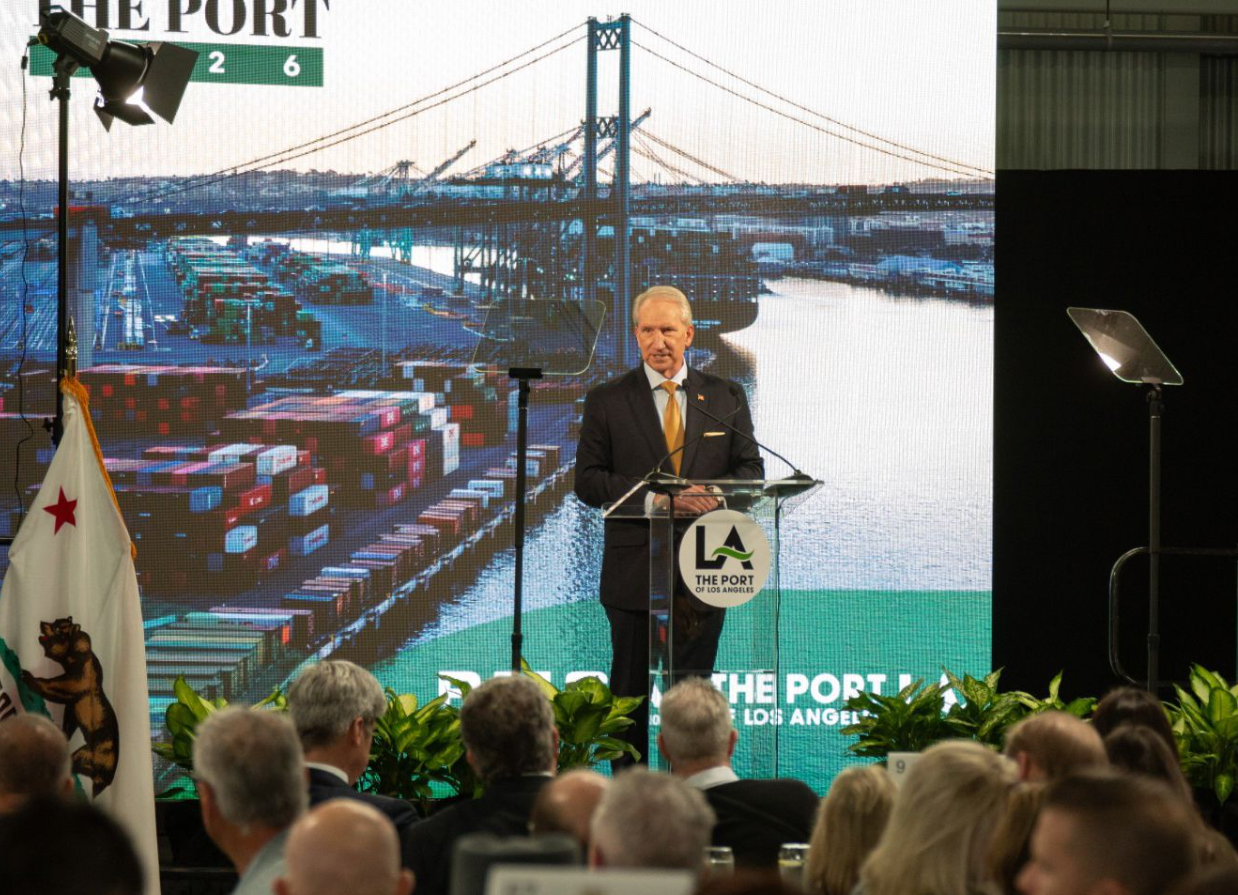
AltaSea kicked off the year by serving as the venue for The Port of Los Angeles and Pacific Merchant Shipping Association’s annual State of the Port event. A record crowd of more than 900 industry and community representatives attended the luncheon, with all proceeds benefitting two local nonprofits, EXP and Toberman Neighborhood Center, both of which provide vital youth enrichment programs and community support services to the harbor area.
The event included speeches by Los Angeles City Councilmember Tim McOsker and Los Angeles Mayor Karen Bass, as well as keynote remarks by Port of Los Angeles Executive Director Gene Seroka. Seroka noted that the port handled over 10 million containers in 2025, making it the third-busiest year in the Port’s history.
Seroka also outlined plans for infrastructure upgrades, including continued investment in addressing port pollution—one of the most significant issues affecting local communities. In 2024, the Port recorded its best year ever for reducing emissions on a per container basis. This progress has been two decades in the making. Since 2005, the Port has cut overall emissions of diesel particulate matter by 90 percent, sulfur oxides by 98 percent, and nitrogen oxides by 73 percent. This progress is of the utmost importance because port pollution, most of which comes from diesel trucks, container ships, and port equipment, negatively impacts both community health and the planet. Pollution from the global shipping industry, for example, is a significant contributor to climate change, accounting for approximately three percent of humanity’s annual greenhouse gas emissions.
The Port of Los Angeles has several ongoing strategies to reduce the climate impact of maritime industries, with the added benefit of continuing to improve air quality in the surrounding communities. This includes transitioning to cleaner-burning fuels as well as incorporating zero-emissions technology in trucks, ships, and port equipment. These strategies all contribute to the Port’s ultimate goal—achieving zero-emissions operations. Since 2025, the Ports of Los Angeles and Long Beach have been developing a “time-bound and enforceable” zero-emissions transition strategy in partnership with the South Coast Air Quality Management District.
Since maritime shipping is inherently global, international cooperation is required in order to truly achieve zero-emissions ports. To that end, the Port of Los Angeles has entered Green Shipping Corridor agreements with eight of the busiest ports in Asia, establishing two-way routes where zero-emission shipping solutions are demonstrated and reported. The aim of these agreements is to reduce emissions enroute and support the transition to low-emission shipping.
AltaSea, the 35-acre sustainable blue campus nestled in the heart of the Port of Los Angeles, is also helping to steward the green transition of both its home port and global maritime industries. On the AltaSea campus, researchers are developing technologies that could decarbonize the shipping industry, including clean hydrogen energy and marine carbon dioxide removal technology optimized for container ships. And Eco Wave Power’s wave energy demonstration at AltaSea is proving that pre-existing port infrastructure can be used to create renewable energy.
In Sacramento, several bills under consideration could also help accelerate the clean air, zero-emissions transition in the Port of Los Angeles. This includes a bill that would require the State Air Resources Board to create competitive funding opportunities for projects that will reduce emissions from port-related activities—giving innovation the economic backing it needs to scale in time to address the climate crisis.
California has long been a leader in legally-binding climate targets. The state successfully met its original emissions-reduction goal four years early, achieving 1990 emission levels in 2016. It then renewed its commitment to fighting climate change by setting a new goal—a law requiring greenhouse gas emissions to be reduced to at least 40% below 1990 levels by 2030. To achieve this target, decarbonizing port industries is of paramount importance, and, as demonstrated in the Port of Los Angeles, this can be achieved through ocean-based solutions.
Written by Emily Vidovich. Emily is an environmental journalist specializing in ocean conservation and climate change mitigation. She obtained her bachelor’s degree at George Washington University and a Masters in Global Environmental Studies at a university in Tokyo, Japan. Born and raised in the Port of Los Angeles, she now works in research and communications at AltaSea.